Our Flagship High Grade Skarn System
Cerro Grande Skarn Corridor
Anchored by a High-Grade Copper-Silver-Gold Discovery
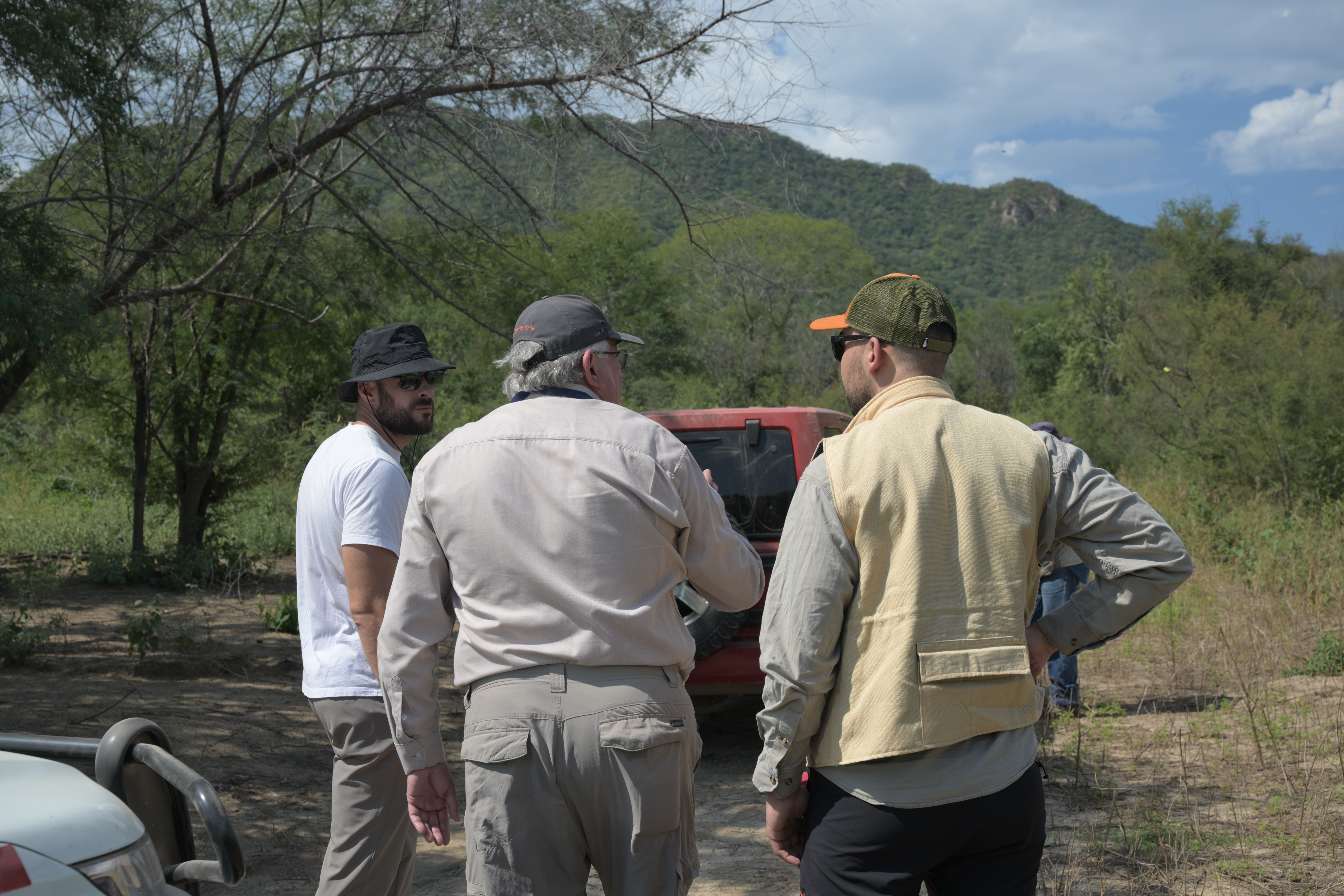
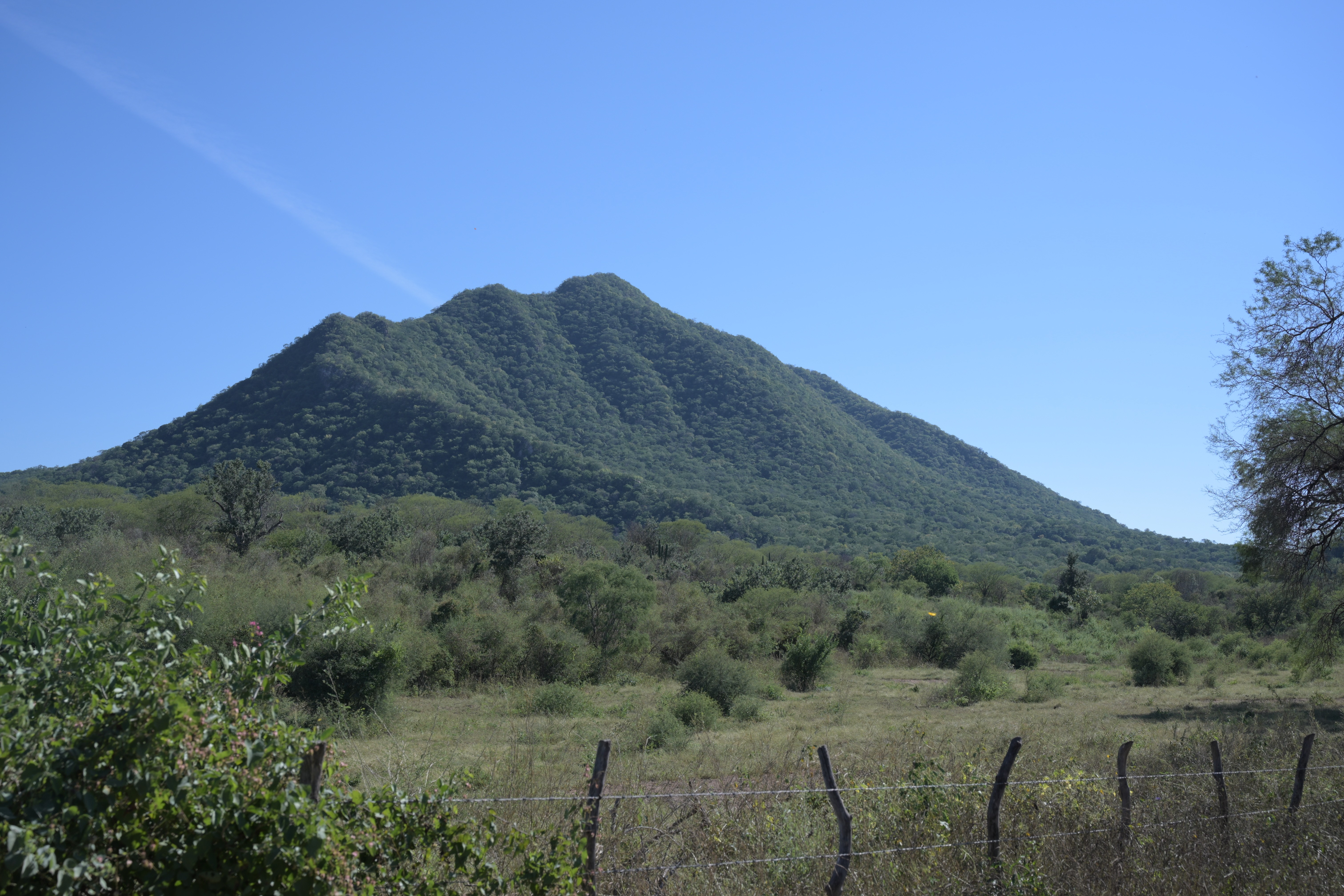
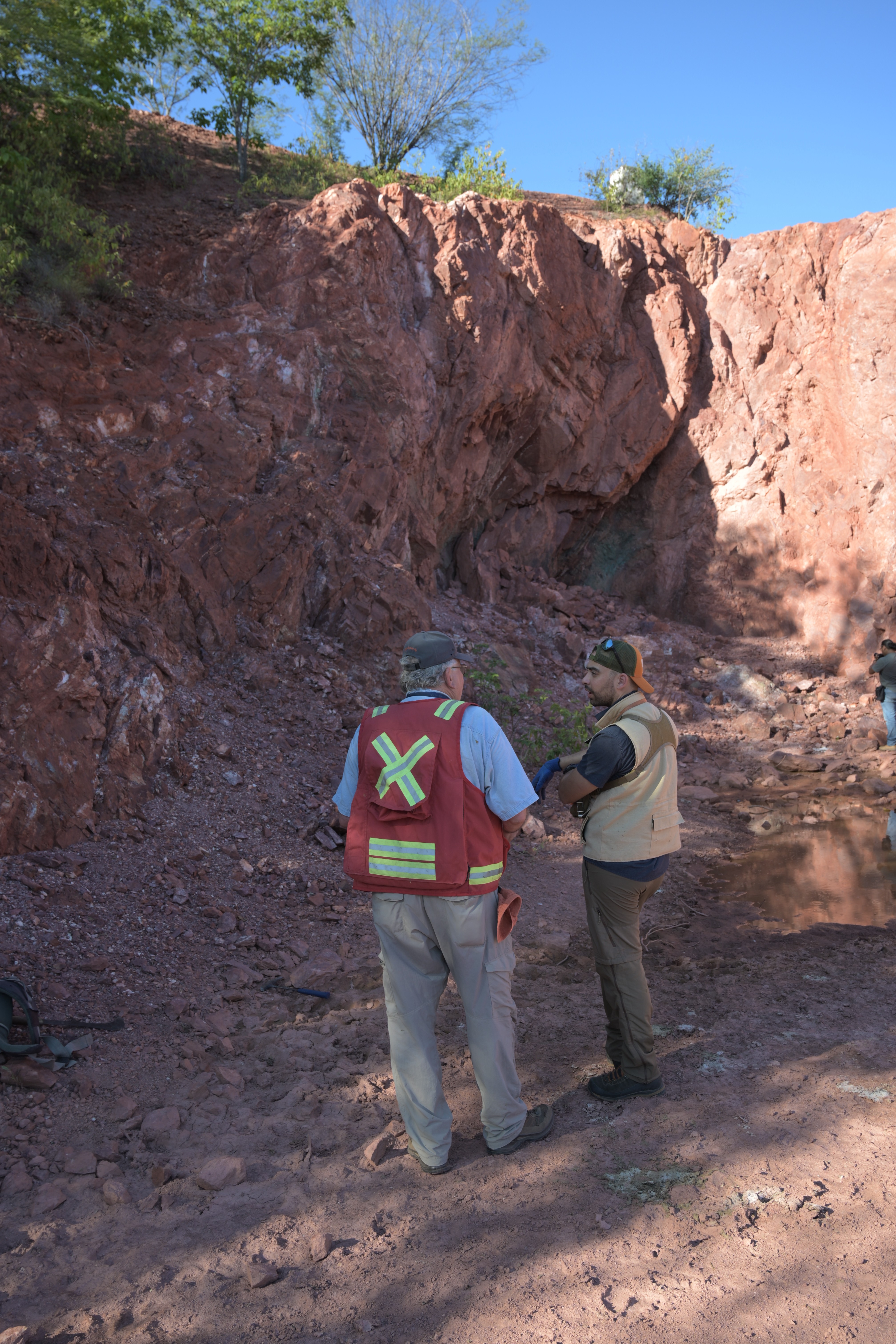
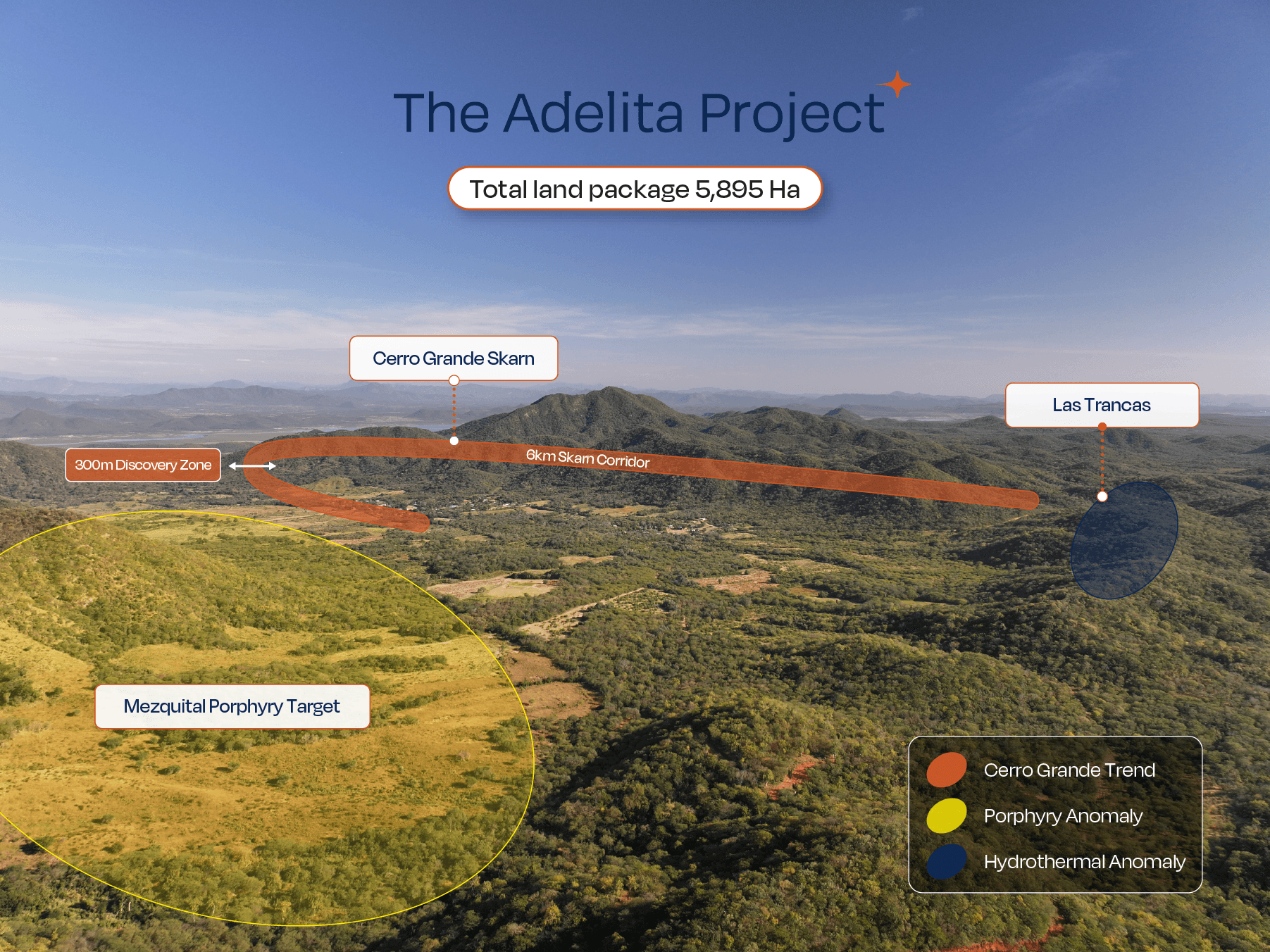
The Cerro Grande Skarn is located in the northern portion of the Adelita concession. The 300 metre high-grade discovery zone hosts 5 layers of Cu-Ag-Au skarn, remaining open in all directions.
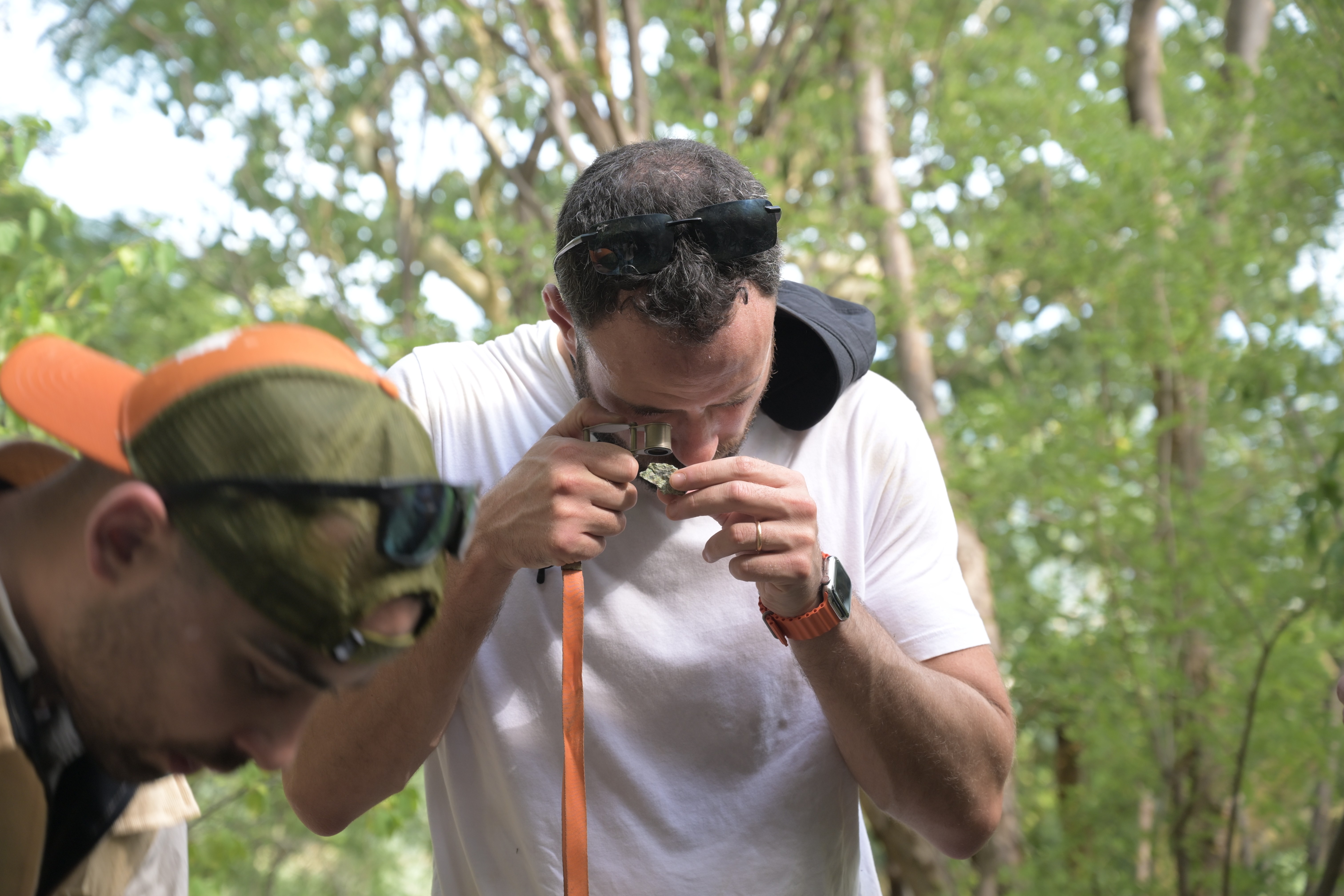
Algo Grande Copper (TSXV: ALGR | OTC: ALGRF | FRA: KM00)
Principal Objective: Cerro Grande Skarn
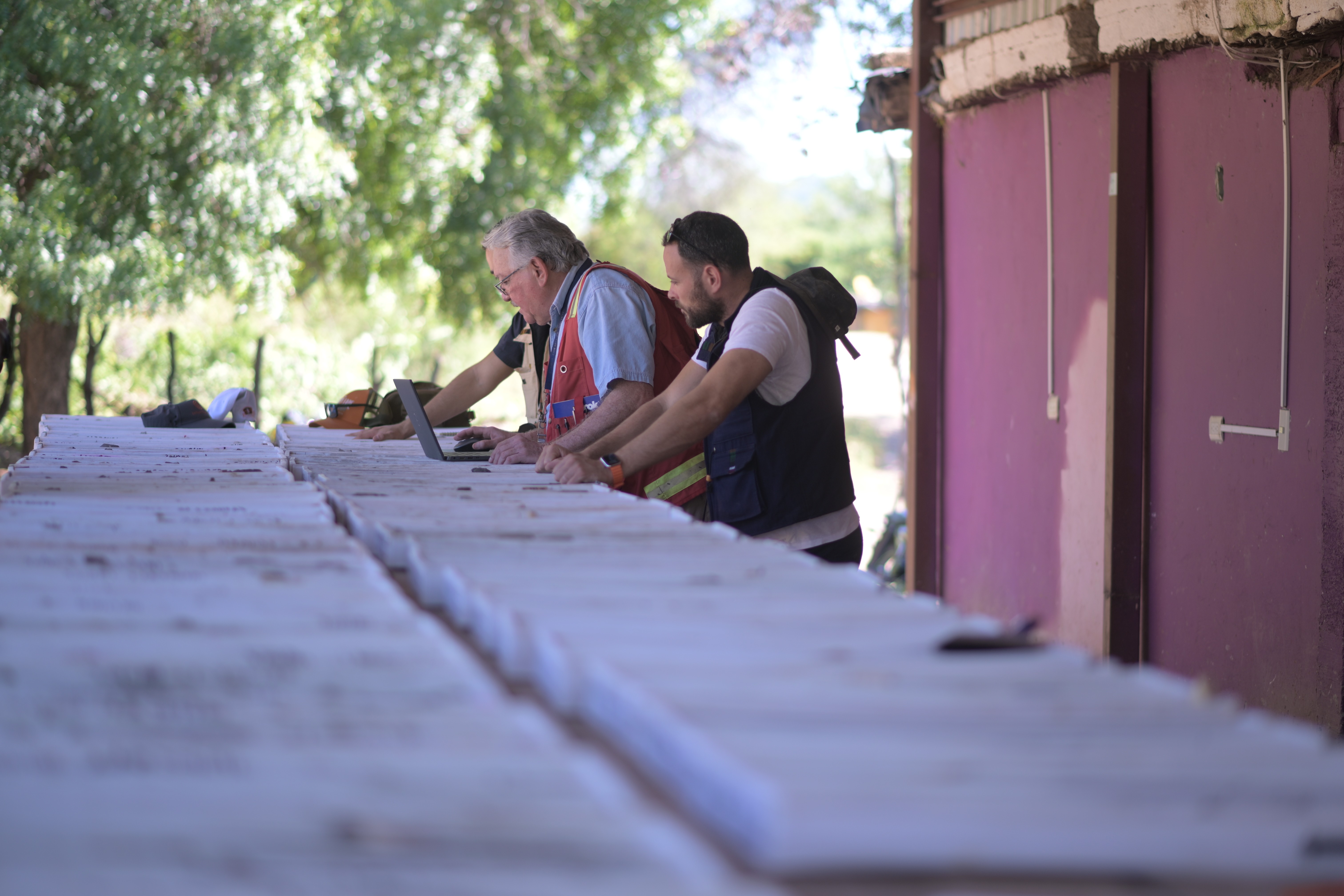
Cerro Grande is the primary focus of the current exploration program, with the principal objective to grow the existing high-grade, near-surface skarn discovery through targeted step-out drilling, delineating a resource.
Cerro Grande is the primary focus of the current exploration program, with the principal objective to grow the existing high-grade, near-surface skarn discovery through targeted step-out drilling, delineating a resource.
Stacked skarn horizons confirmed: Drilling supports a multi-horizon, vertically extensive skarn system, with mineralization open along strike and at depth.
Stacked skarn horizons confirmed: Drilling supports a multi-horizon, vertically extensive skarn system, with mineralization open along strike and at depth.
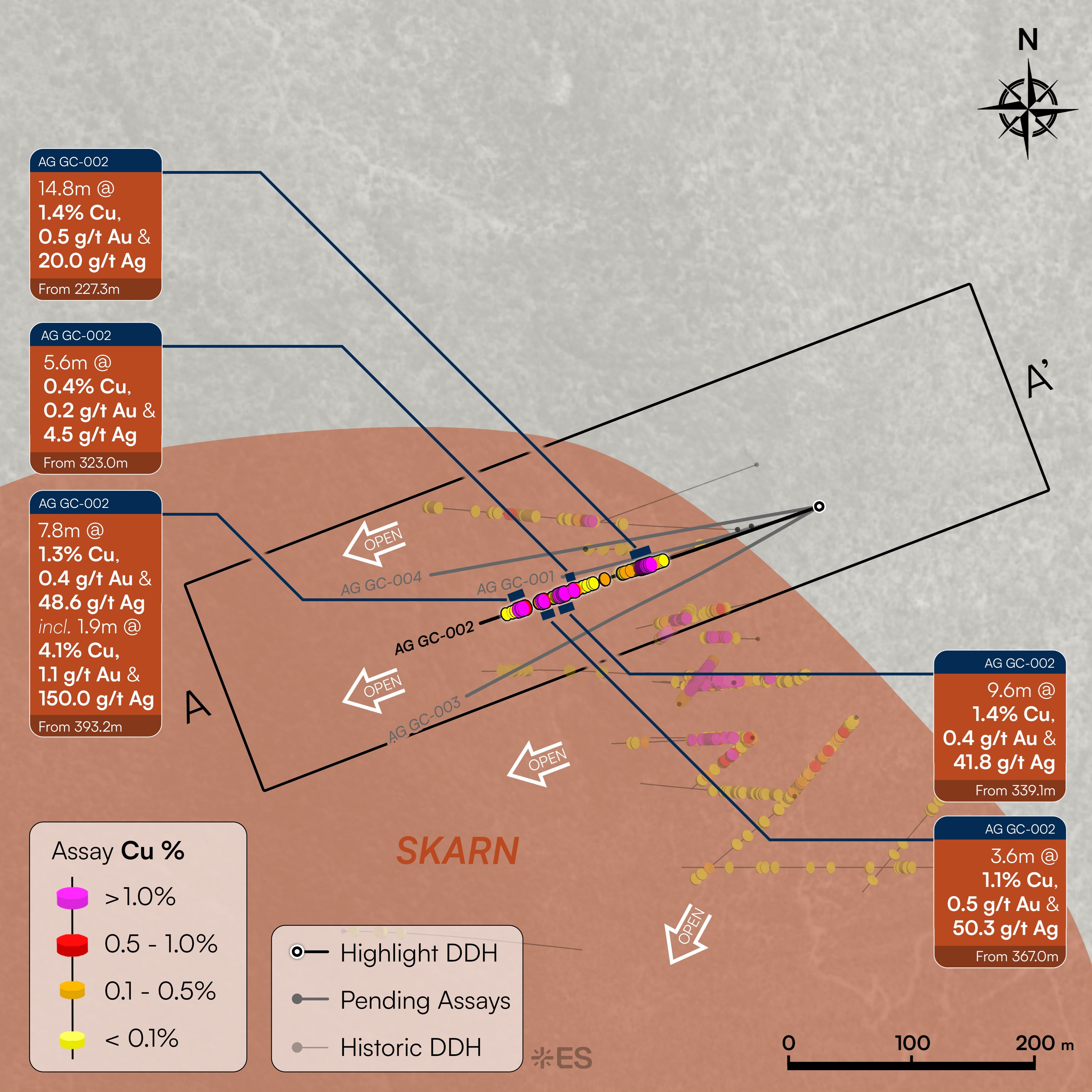
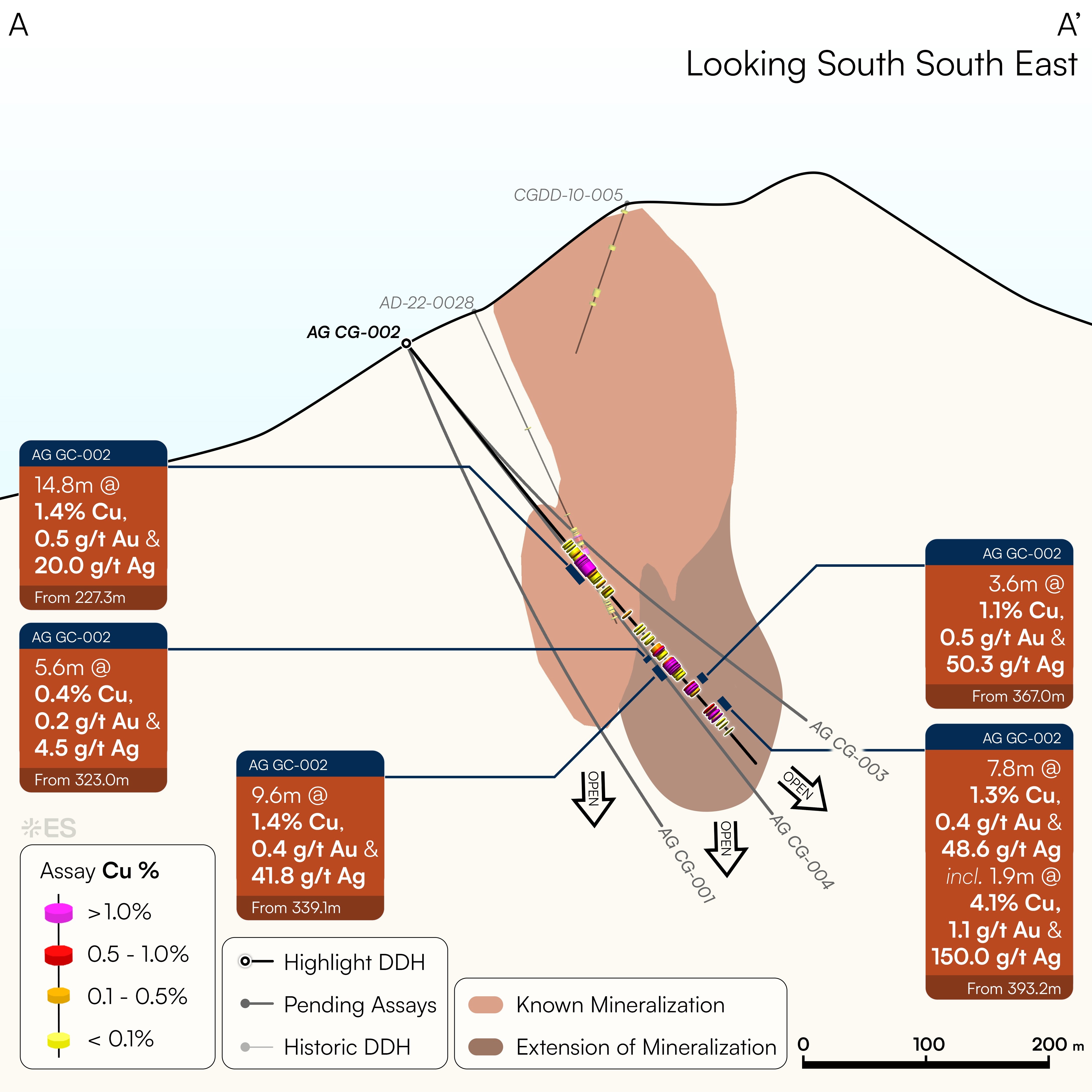
Strong inaugural results: Multiple mineralized intervals were intersected, including 14.8 m @ 1.4% Cu, 20.0 g/t Ag & 0.5 g/t Au (from 227.3 m).
Strong inaugural results: Multiple mineralized intervals were intersected, including 14.8 m @ 1.4% Cu, 20.0 g/t Ag & 0.5 g/t Au (from 227.3 m).
New mineralization below historic drilling: Step-out/deeper drilling intersected additional skarn horizons below prior drilling, materially expanding the interpreted scale potential
New mineralization below historic drilling: Step-out/deeper drilling intersected additional skarn horizons below prior drilling, materially expanding the interpreted scale potential
High-grade depth intercepts: Deeper intervals include 9.6 m @ 1.4% Cu, 41.8 g/t Ag & 0.4 g/t Au (from 339.1 m) and 7.8 m @ 1.3% Cu, 48.6 g/t Ag & 0.4 g/t Au, including 1.9 m @ 4.1% Cu (from 393.2 m).
High-grade depth intercepts: Deeper intervals include 9.6 m @ 1.4% Cu, 41.8 g/t Ag & 0.4 g/t Au (from 339.1 m) and 7.8 m @ 1.3% Cu, 48.6 g/t Ag & 0.4 g/t Au, including 1.9 m @ 4.1% Cu (from 393.2 m).
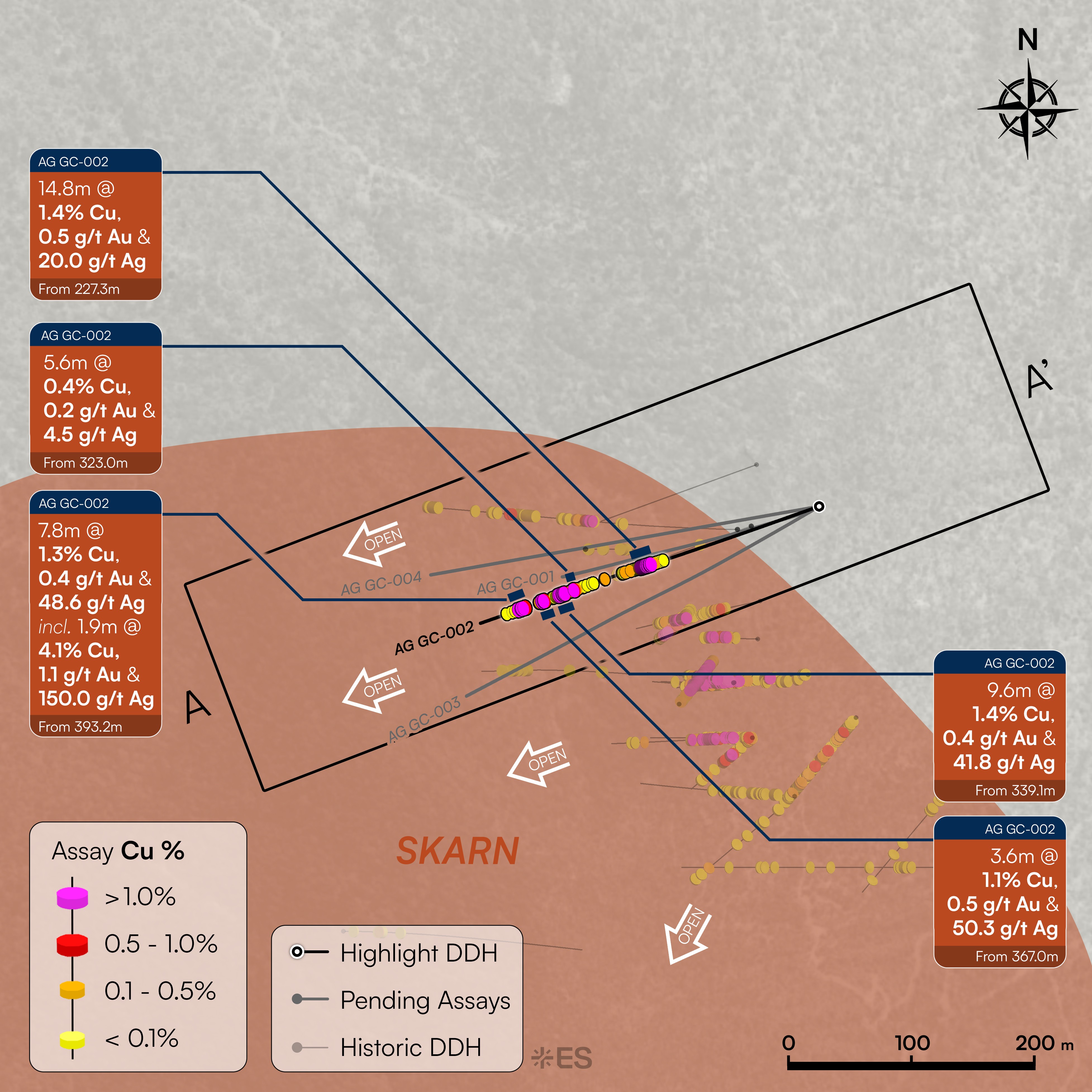
Vertically stacked skarn corridor with scale potential and plenty of room to grow.
Vertically stacked skarn corridor with scale potential and plenty of room to grow.
Cerro Grande sits within a structurally active intrusive–carbonate corridor that is highly prospective for copper–silver–gold skarn mineralization.
Inaugural drilling supports a multi-horizon, vertically extensive skarn system, with new skarn horizons identified below historic drilling and mineralization remaining open along strike and at depth. This provides a strong foundation for continued step-out and deeper drilling as we systematically expand the footprint and advance toward resource delineation.
Cerro Grande sits within a structurally active intrusive–carbonate corridor that is highly prospective for copper–silver–gold skarn mineralization.
Inaugural drilling supports a multi-horizon, vertically extensive skarn system, with new skarn horizons identified below historic drilling and mineralization remaining open along strike and at depth. This provides a strong foundation for continued step-out and deeper drilling as we systematically expand the footprint and advance toward resource delineation.
Description Of The Mineralised Skarn Horizons
Upper Skarn Section 1
Upper Skarn Section 1
Upper Skarn Section 1
The uppermost mineralized skarn was intersected between (227.26m – 242.05m), returning 14.79 m averaging 1.4% Cu, 20 g/t Ag and 0.5 g/t Au.
This section is characterized by a magnetite-rich skarn with brown and green garnet assemblages, hosting disseminated and vein-controlled chalcopyrite, bornite and chalcocite.
The thickness and grade of this section are consistent with the upper skarn zones encountered in historical drilling, confirming down-dip continuity.
The uppermost mineralized skarn was intersected between (227.26m – 242.05m), returning 14.79 m averaging 1.4% Cu, 20 g/t Ag and 0.5 g/t Au.
This section is characterized by a magnetite-rich skarn with brown and green garnet assemblages, hosting disseminated and vein-controlled chalcopyrite, bornite and chalcocite.
The thickness and grade of this section are consistent with the upper skarn zones encountered in historical drilling, confirming down-dip continuity.
Figure 1 - Skarn section 1 - Magnetite rich skarn
Figure 1 - Skarn section 1 - Magnetite rich skarn
Intermediate Skarn Horizon Section 2
Intermediate Skarn Horizon Section 2
Intermediate Skarn Horizon Section 2
A second mineralized interval was intersected between (323.00m-328.57m), grading 5.57m @ 0.4 % Cu, 4.5 g/t Ag, 0.2 g/t Au.
This section occurs proximal to intrusive contacts and displays skarn and skarnoid textures, with disseminated copper sulphides, and chrysocolla along fractures, the skarn presents fine grain green garnets and insignificant magnetite
A second mineralized interval was intersected between (323.00m-328.57m), grading 5.57m @ 0.4 % Cu, 4.5 g/t Ag, 0.2 g/t Au.
This section occurs proximal to intrusive contacts and displays skarn and skarnoid textures, with disseminated copper sulphides, and chrysocolla along fractures, the skarn presents fine grain green garnets and insignificant magnetite
Figure 2 - Skarn section 2 - Fine grain green garnet
Figure 2 - Skarn section 2 - Fine grain green garnet
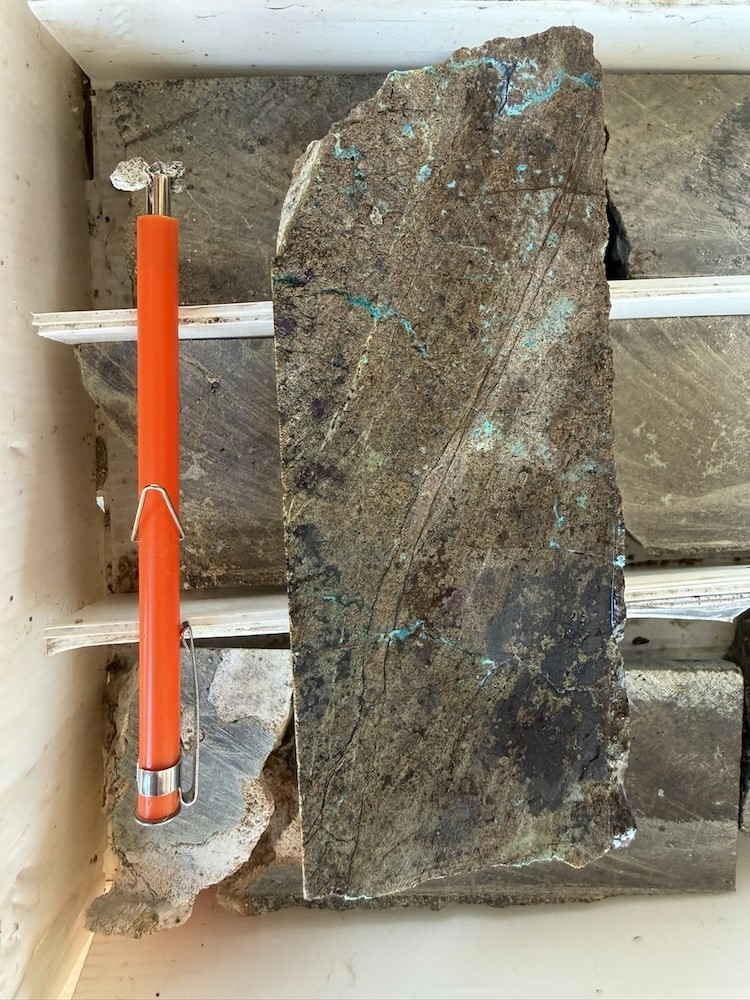
Figure 2
Newly Discovered Lower Skarn Section 3 to 5
Newly Discovered Lower Skarn Section 3 to 5
Newly Discovered Lower Skarn Section 3 to 5
Three previously unknown mineralized skarn sections were intersected below 339 meters, representing a significant exploration breakthrough.
The first new horizon (339.10m – 348.65m), returned 9.55m @ 1.4% Cu, 41.8 g/t Ag, 0.4 g/t Au. This interval is characterized by fine grained green garnet skarn, with abundant magnetite and strong copper sulphide development, including chalcocite and chalcopyrite, locally accompanied by silver-rich sulphides
Three previously unknown mineralized skarn sections were intersected below 339 meters, representing a significant exploration breakthrough.
The first new horizon (339.10m – 348.65m), returned 9.55m @ 1.4% Cu, 41.8 g/t Ag, 0.4 g/t Au. This interval is characterized by fine grained green garnet skarn, with abundant magnetite and strong copper sulphide development, including chalcocite and chalcopyrite, locally accompanied by silver-rich sulphides
Figure 3 - Skarn section 3 - Fine grain green-garnet skarn with copper and abundance of magnetite
Figure 3 - Skarn section 3 - Fine grain green-garnet skarn with copper and abundance of magnetite
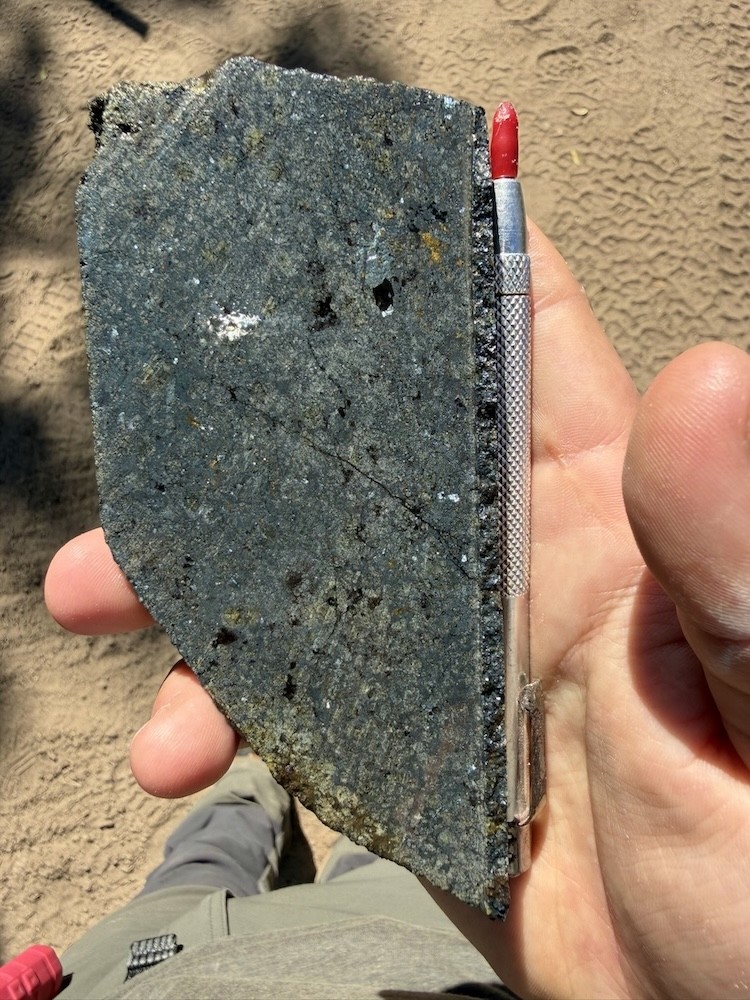
Figure 3
A second newly identified section (367.00 and 370.85m), returning 3.85m @ 1.1 % Cu, 50.3 g/t Ag, 0.5 g/t Au.
This interval comprises coarse grained garnet skarn with elevated silver values with copper sulphides and oxides disseminated and along fractures, suggesting a enhanced fluid flux or metal zonation at this structural level, with silver introduced or remobilized during a later fluid pulse rather than during peak skarn formation.
A second newly identified section (367.00 and 370.85m), returning 3.85m @ 1.1 % Cu, 50.3 g/t Ag, 0.5 g/t Au.
This interval comprises coarse grained garnet skarn with elevated silver values with copper sulphides and oxides disseminated and along fractures, suggesting a enhanced fluid flux or metal zonation at this structural level, with silver introduced or remobilized during a later fluid pulse rather than during peak skarn formation.
Figure 4 - Skarn section 4 - Green-garnet skarn with copper and silver sulphides (note the skarn front in the axis of the core sample)
Figure 4 - Skarn section 4 - Green-garnet skarn with copper and silver sulphides (note the skarn front in the axis of the core sample)
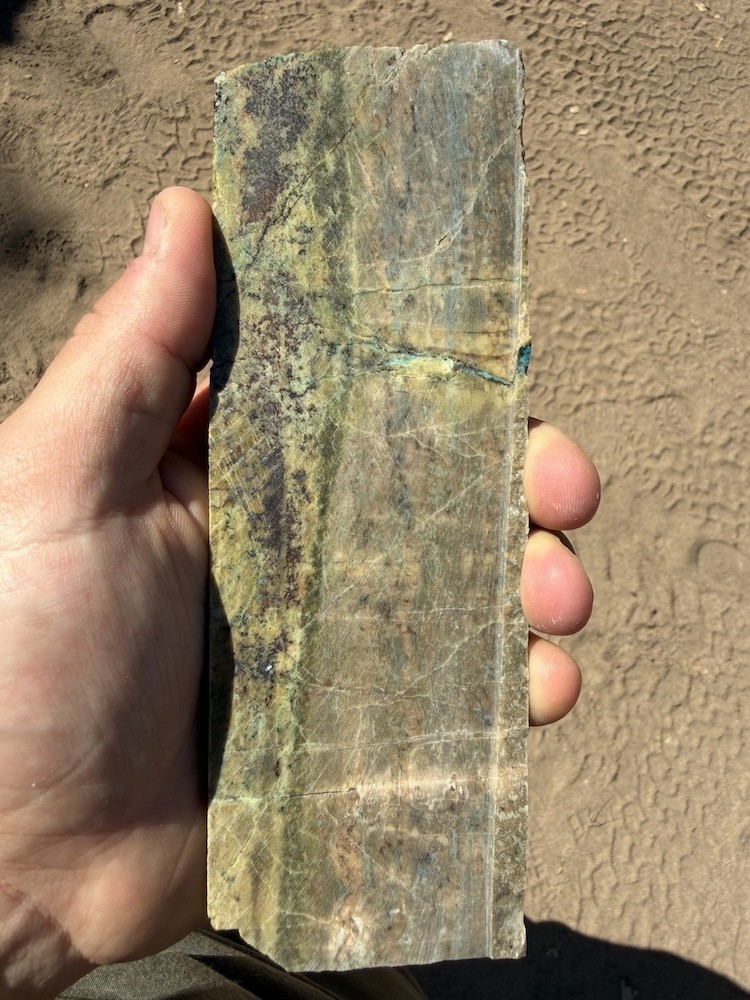
Figure 4
The deepest mineralized skarn horizon (393.17m-401m) returned, 7.83m @ 1.3% Cu, 48.6 g/t Ag, 0.4 g/t Au, including a high-grade intervale of 1.85 m @ 4.1 % Cu, 150 g/t Ag and 1.1 g/t Au.
This horizon exhibits strong copper-gold-silver enrichment associated with well-developed garnet skarn and sulphide assemblages, indicating a robust mineralizing system at depth
The deepest mineralized skarn horizon (393.17m-401m) returned, 7.83m @ 1.3% Cu, 48.6 g/t Ag, 0.4 g/t Au, including a high-grade intervale of 1.85 m @ 4.1 % Cu, 150 g/t Ag and 1.1 g/t Au.
This horizon exhibits strong copper-gold-silver enrichment associated with well-developed garnet skarn and sulphide assemblages, indicating a robust mineralizing system at depth
Figure 5 - Skarn section 5 - Green-garnet skarn with copper sulphides, disseminated and along fractures
Figure 5 - Skarn section 5 - Green-garnet skarn with copper sulphides, disseminated and along fractures
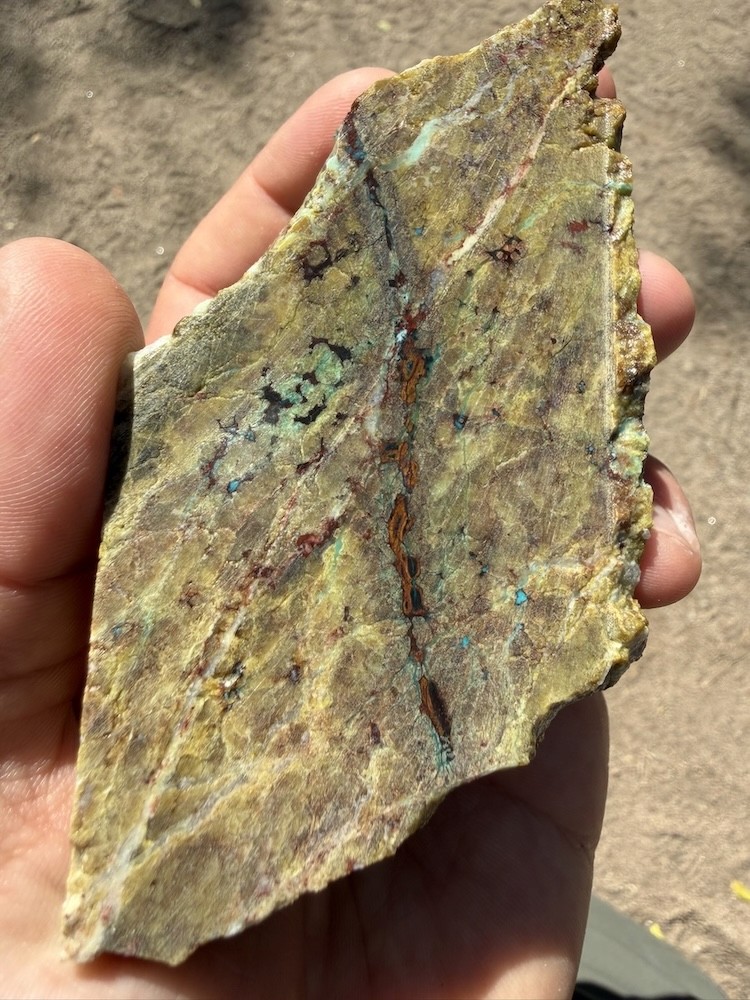
Figure 5
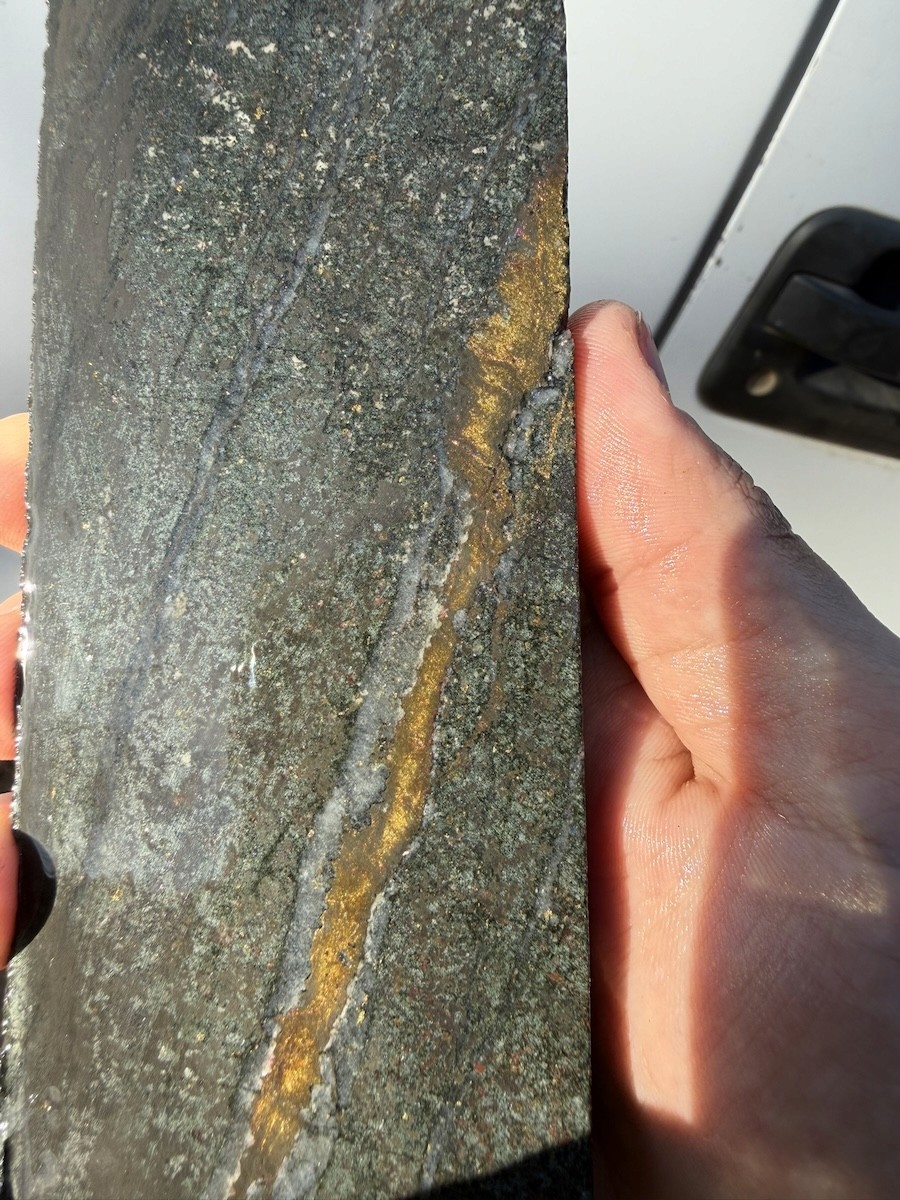
Figure 1
Figure 1
Algo Grande Copper
Algo Grande Drilling
Significant intersects of Algo Grande inaugural drilling campaign
Algo Grande Copper
Algo Grande Drilling
Significant intersects of Algo Grande inaugural drilling campaign
Hole | Intersect Type | From (m) | To (m) | Interval (m) | CuEq (%) | Cu (%) | Ag (g/t) | Au (g/t) |
|---|---|---|---|---|---|---|---|---|
AG_GC_002 | Main | 227.26 | 242.05 | 14.8 | 1.8 | 1.4 | 20 | 0.5 |
Main | 323 | 328.57 | 5.6 | 0.5 | 0.4 | 4.5 | 0.2 | |
Main | 339.1 | 348.65 | 9.5 | 1.9 | 1.4 | 41.8 | 0.4 | |
Main | 367 | 370.85 | 3.9 | 1.8 | 1.1 | 50.3 | 0.5 | |
Main | 393.17 | 401 | 7.8 | 1.9 | 1.3 | 48.6 | 0.4 | |
Included | 395.8 | 397.65 | 1.8 | 5.8 | 4.1 | 150.5 | 1.1 | |
AG_GC_003 | Main | 214.96 | 233.11 | 18.2 | 1.8 | 1.2 | 28.2 | 0.7 |
Included | 221.12 | 224.67 | 3.5 | 3.9 | 2.4 | 61.1 | 1.8 | |
Main | 249.41 | 250.4 | 1 | 2 | 1 | 34.6 | 1.1 | |
Main | 269.15 | 270.95 | 1.8 | 2.2 | 1.4 | 46.1 | 0.8 | |
AG_GC_004 | Main | 334.5 | 337.58 | 3.1 | 1 | 0.7 | 26.9 | 0.3 |
Hole | Intersect Type | From (m) | To (m) | Interval (m) | CuEq (%) | Cu (%) | Ag (g/t) | Au (g/t) |
|---|---|---|---|---|---|---|---|---|
AG_GC_002 | Main | 227.26 | 242.05 | 14.8 | 1.8 | 1.4 | 20 | 0.5 |
Main | 323 | 328.57 | 5.6 | 0.5 | 0.4 | 4.5 | 0.2 | |
Main | 339.1 | 348.65 | 9.5 | 1.9 | 1.4 | 41.8 | 0.4 | |
Main | 367 | 370.85 | 3.9 | 1.8 | 1.1 | 50.3 | 0.5 | |
Main | 393.17 | 401 | 7.8 | 1.9 | 1.3 | 48.6 | 0.4 | |
Included | 395.8 | 397.65 | 1.8 | 5.8 | 4.1 | 150.5 | 1.1 | |
AG_GC_003 | Main | 214.96 | 233.11 | 18.2 | 1.8 | 1.2 | 28.2 | 0.7 |
Included | 221.12 | 224.67 | 3.5 | 3.9 | 2.4 | 61.1 | 1.8 | |
Main | 249.41 | 250.4 | 1 | 2 | 1 | 34.6 | 1.1 | |
Main | 269.15 | 270.95 | 1.8 | 2.2 | 1.4 | 46.1 | 0.8 | |
AG_GC_004 | Main | 334.5 | 337.58 | 3.1 | 1 | 0.7 | 26.9 | 0.3 |
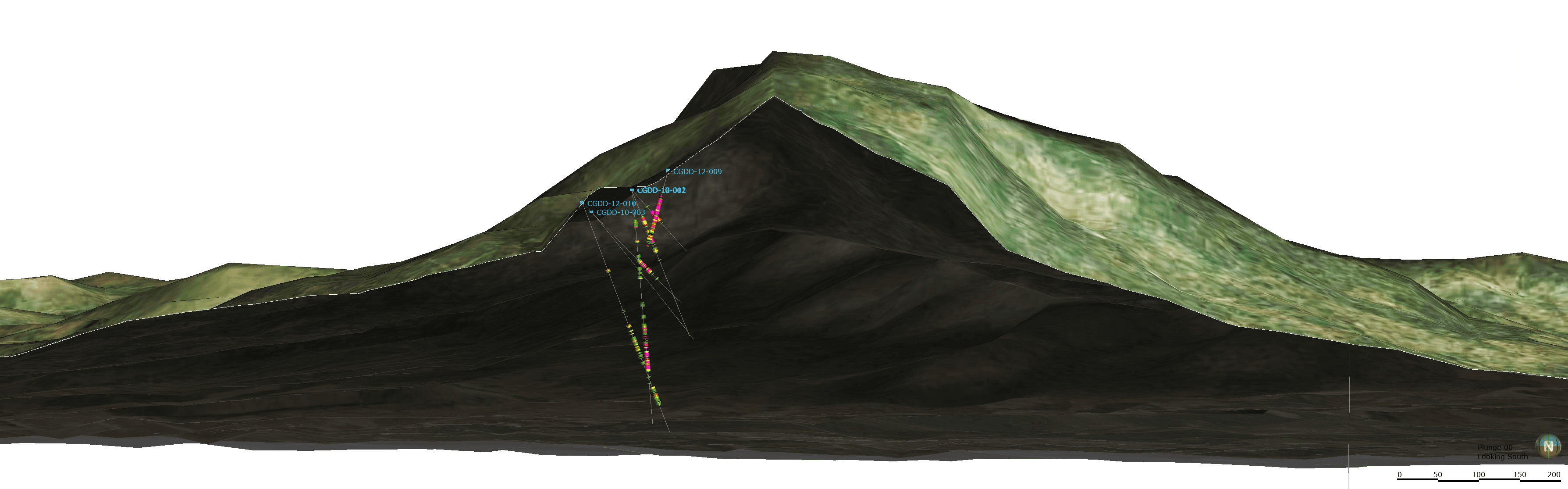
Cerro Grande Cross Section
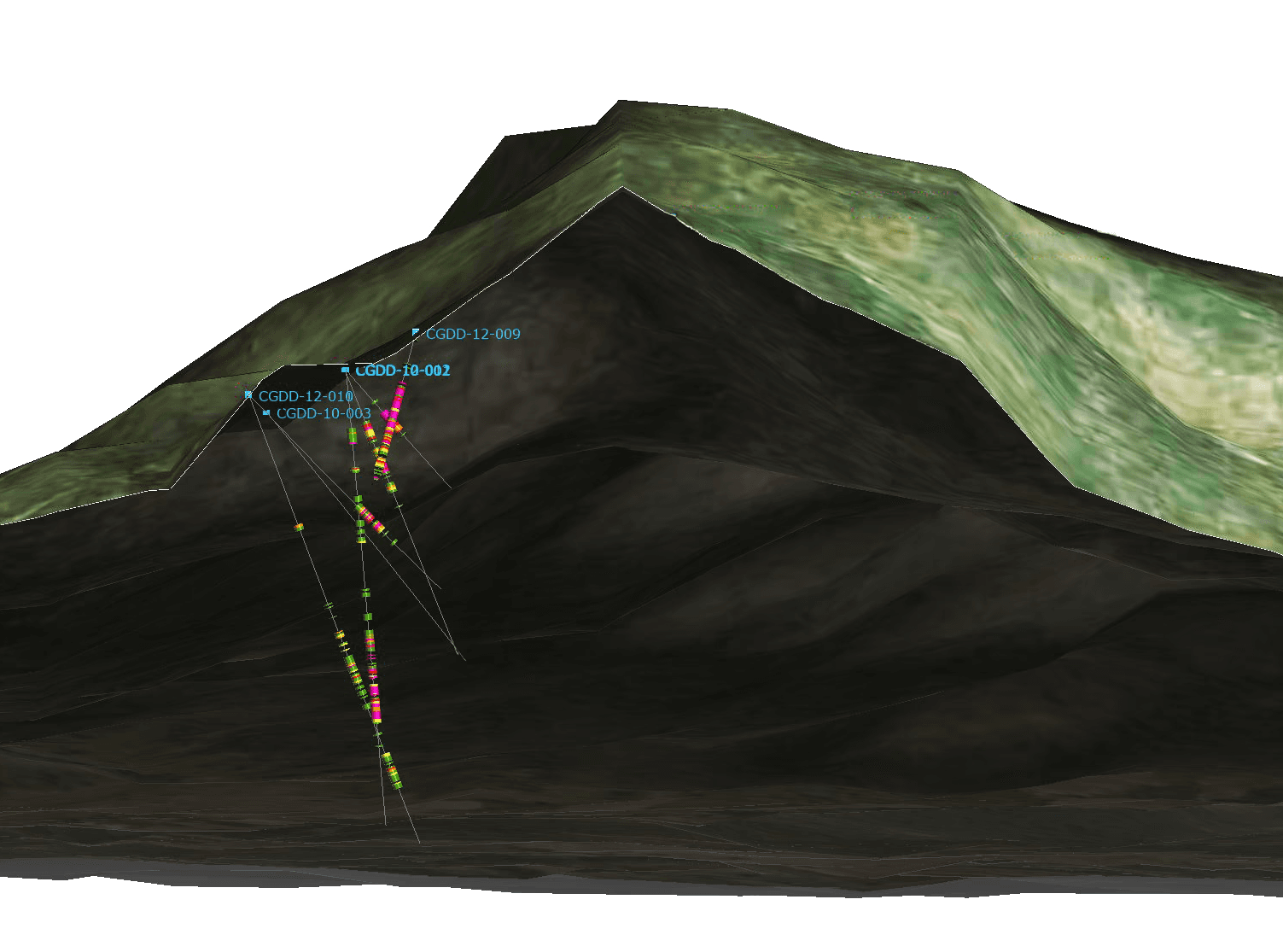
Cerro Grande Cross Section
Open at Depth and Laterally
Testing the immediate Cerro Grande Skarn extensions with the aim to identify and grow the existing discovery.
Algo Grande Copper
Exploration Outlook
Building on the discovery of five stacked skarn horizons and the confirmation of high-grade continuity at depth, the next phase will target expansion of the mineralized envelope along the 6 km-long trend and vectoring toward a potential porphyry source.
Building on the discovery of five stacked skarn horizons and the confirmation of high-grade continuity at depth, the next phase will target expansion of the mineralized envelope along the 6 km-long trend and vectoring toward a potential porphyry source.


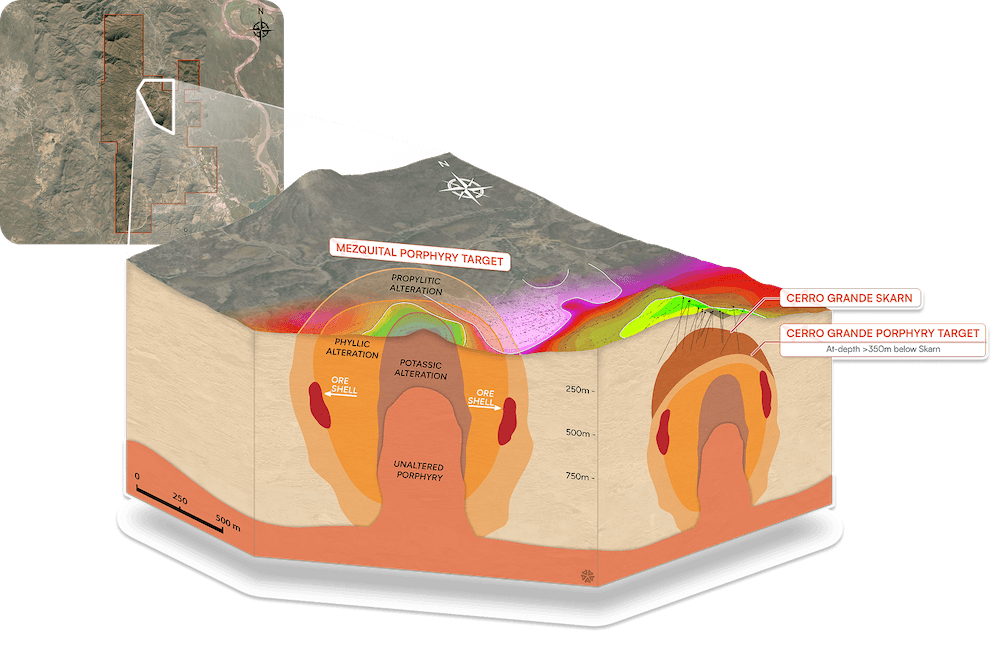
The cross-section illustrates the interpreted subsurface geometry of the Mezquital & Cerro Grande Porphyry Target at Adelita.
The cross-section illustrates the interpreted subsurface geometry of the Mezquital & Cerro Grande Porphyry Target at Adelita.
The cross-section illustrates the interpreted subsurface geometry of the Mezquital & Cerro Grande Porphyry Target at Adelita.
The cross-section illustrates the interpreted subsurface geometry of the Mezquital & Cerro Grande Porphyry Target at Adelita.
Drilling, surface mapping, and alteration patterns indicate a porphyry intrusion at depth, with a potassic core surrounded by phyllic and propylitic alteration and associated copper-bearing ore shells.
Drilling, surface mapping, and alteration patterns indicate a porphyry intrusion at depth, with a potassic core surrounded by phyllic and propylitic alteration and associated copper-bearing ore shells.
Drilling, surface mapping, and alteration patterns indicate a porphyry intrusion at depth, with a potassic core surrounded by phyllic and propylitic alteration and associated copper-bearing ore shells.
The Cerro Grande skarn at surface is interpreted as the upper expression of this system, while the model highlights strong potential for a large, continuous porphyry copper body extending below and adjacent to known mineralization
The Cerro Grande skarn at surface is interpreted as the upper expression of this system, while the model highlights strong potential for a large, continuous porphyry copper body extending below and adjacent to known mineralization
The Cerro Grande skarn at surface is interpreted as the upper expression of this system, while the model highlights strong potential for a large, continuous porphyry copper body extending below and adjacent to known mineralization
Unlocking a District-Scale Copper-Gold System
Five stacked skarn horizons confirmed, including three newly discovered. High-grade copper-silver-gold mineralization remains open in multiple directions.
Five stacked skarn horizons confirmed, including three newly discovered. High-grade copper-silver-gold mineralization remains open in multiple directions.
Our inaugural drill program has advanced Cerro Grande from a historical occurrence into a multi-horizon, stacked Cu-Au skarn system with porphyry affinity. The next phase is designed to aggressively expand the mineralized footprint and define the system architecture:
Vertical Extension: Systematic drilling above and below the newly identified horizons and follow-up on porphyry intersects.
Strike Extension: Step out drilling along the 6 km corridor, to demonstrate lateral continuity of newly identified system, advancing a district-scale structural framework.
Positioned as more than a single-zone discovery, Cerro Grande is being advanced as a scalable, multi-horizon copper-gold system: Built for systematic expansion along trend and at depth as we define the broader architecture and growth potential.
Our inaugural drill program has advanced Cerro Grande from a historical occurrence into a multi-horizon, stacked Cu-Au skarn system with porphyry affinity. The next phase is designed to aggressively expand the mineralized footprint and define the system architecture:
Vertical Extension: Systematic drilling above and below the newly identified horizons and follow-up on porphyry intersects.
Strike Extension: Step out drilling along the 6 km corridor, to demonstrate lateral continuity of newly identified system, advancing a district-scale structural framework.
Positioned as more than a single-zone discovery, Cerro Grande is being advanced as a scalable, multi-horizon copper-gold system: Built for systematic expansion along trend and at depth as we define the broader architecture and growth potential.
PART OF A BIGGER SYSTEM
PART OF A BIGGER SYSTEM
The Adelita Project
Current evidence indicates that the Adelita Project of Algo Grande Copper hosts multiple mineral systems. Together, these systems point to a district-scale opportunity with the potential to support multiple deposits across the property.
Current evidence indicates that the Adelita Project of Algo Grande Copper hosts multiple mineral systems. Together, these systems point to a district-scale opportunity with the potential to support multiple deposits across the property.
Explore the full Adelita Project
Explore the full Adelita Project
Dive into our interactive VRIFY model to explore all aspects of the Adelita Project
Dive into our interactive VRIFY model to explore all aspects of the Adelita Project
Get an overview of the project, learn more about the location, explore the interactive maps and dive deeper into the results.
Get an overview of the project, learn more about the location, explore the interactive maps and dive deeper into the results.
*43-101 Disclaimer References
The scientific and technical information contained in this website has been reviewed and approved by Mr. Lorne Warner, P. Geo., an independent Qualified Person for Algo Grande Copper Corp. as defined in NI 43-101.
Mr. Warner has examined information regarding the historical exploration at the Adelita copper project, which includes his review of the historical sampling, analytical and procedures and two site visits to verify drill collar locations and personally collect rock samples for analysis. Mr. Warner also completed a technical report on the Adelita Project prepared in accordance with NI 43-101 dated effective August 15, 2025, which is available under the Company’s profile at www.sedarplus.ca.
Management notes that historical results were collected and reported by operators unrelated to the Company but have been verified by its Qualified Person; as a result, the historical results create a scientific basis for ongoing work on the Adelita property. Management cautions that historical results, discoveries and any published resource estimates on adjacent or nearby mineral properties, whether in stated current resource estimates or historical resource estimates, are not necessarily indicative of the results that may be achieved on the Adelita property.
*43-101 Disclaimer References
The scientific and technical information contained in this website has been reviewed and approved by Mr. Lorne Warner, P. Geo., an independent Qualified Person for Algo Grande Copper Corp. as defined in NI 43-101.
Mr. Warner has examined information regarding the historical exploration at the Adelita copper project, which includes his review of the historical sampling, analytical and procedures and two site visits to verify drill collar locations and personally collect rock samples for analysis. Mr. Warner also completed a technical report on the Adelita Project prepared in accordance with NI 43-101 dated effective August 15, 2025, which is available under the Company’s profile at www.sedarplus.ca.
Management notes that historical results were collected and reported by operators unrelated to the Company but have been verified by its Qualified Person; as a result, the historical results create a scientific basis for ongoing work on the Adelita property. Management cautions that historical results, discoveries and any published resource estimates on adjacent or nearby mineral properties, whether in stated current resource estimates or historical resource estimates, are not necessarily indicative of the results that may be achieved on the Adelita property.
Subscribe for the Latest
Get emails and SMS on the latest investor news, discovery progress and company milestones
Algo Grande is a copper exploration company advancing the Adelita project, anchored by a near-surface Cu-Ag-Au skarn discovery, located within the prolific Sonora-Arizona Porphyry Belt.
TSXV: ALGR | OTC: ALGRF | FRA: KM00
Reach Us
+1 (778) 907-2547
Suite 1507 – 1030 West Georgia Street,
Vancouver, BC, Canada, V6E 2Y3
Cautionary Statement
This website (the “Website”) of Algo Grande Copper Corp. (the “Company”) is dated January 2026. It is information in a summary form and does not purport to be complete. It is not intended to be relied upon as advice to investors or potential investors and does not address the investment objectives, financial situation or needs of any particular investor.
Certain statements contained in this Website constitute “forward-looking information” as such term is defined in applicable Canadian securities legislation, including statements relating to the acquisition of the Adelita Project and the proposed exploration and development activities and prospects for the Adelita Project. The words “may”, “would”, “could”, “should”, “potential”, “will”, “seek”, “intend”, “plan”, “anticipate”, “believe”, “estimate”, “expect” and similar expressions as they relate to the Company, are intended to identify forward-looking information. All statements other than statements of historical fact may be forward-looking information. Such statements reflect the Company’s current views and intentions with respect to future events, and current information available to the Company, and are subject to certain risks, uncertainties and assumptions. Many factors could cause the actual results, performance or achievements that may be expressed or implied by such forward- looking information to vary from those described herein should one or more of these risks or uncertainties materialize. Certain of the “risk factors” that could cause actual results to differ materially from the Company’s forward-looking statements include, without limitation, the following: risks related to the receipt of all necessary third party and regulatory approvals, including stock exchange approval and environmental approvals; changes in project parameters as plans continue to be refined; fluctuations in prices of commodities, including copper; failure of plant, equipment or processes to operate as anticipated; accidents, labour disputes, title disputes, claims and limitations on insurance coverage and other risks of the mining industry; delays in the completion of exploration, development or construction activities; health and safety risks; climate change risks; risks related to potential opposition from non-governmental organizations and public interest groups; changes in national and local government regulation of mining operations, tax rules and regulations, and political and economic developments in Mexico; reliance on management and dependence on key personnel; competition in the mining industry; risks related to international operations; fluctuations in foreign currency exchange rates; substantial capital requirements and liquidity; uninsurable risks; litigation; risks related to and uncertainty associated with general economic conditions, actual results of current exploration activities, unanticipated reclamation expenses; and other factors beyond the control of the Company. The material assumptions upon which forward-looking statements in this Website are based include, (i) the results from any future exploration that may be undertaken by the Company will align with expectations and prior results; (ii) the availability of experienced staff and the Company’s ability to source resources to carry out its activities; (iii) future demand and trends in industries in which the Company may participate; (iv) the Company’s ability to continue to work with project partners, stakeholders, community leaders and regulatory bodies; (v) the Company’s ability to effectively compete for customers, suppliers and talent; and (vi) stable market and general economic conditions. Should any factor affect the Company in an unexpected manner, or should assumptions underlying the forward-looking information prove incorrect, the actual results or events may differ materially from the results or events predicted.
Any such forward-looking information is expressly qualified in its entirety by this cautionary statement. The forward-looking information included in this website is made as of the date of this Website and the Company undertakes no obligation to publicly update or revise any forward- looking information, other than as required by applicable law.
The information contained in this website is derived solely from management of the Company and otherwise publicly available information which the Company believes to be trustworthy, and does not purport to be all-inclusive or to contain all the information that an investor may desire to have in evaluating whether or not to make an investment in the Company. The information has not been independently verified and is subject to material updating, revision and further amendment, and is qualified entirely by reference to the disclaimers contained herein and/or any other legal disclosure document(s). No representation or warranty, express or implied, is made or given by or on behalf of the Company, or any of its respective affiliates, directors, officers or employees as to the accuracy, completeness or fairness of the information or opinions contained in this website and no responsibility or liability is accepted by any person for such information or opinions. The Company does not undertake or agree to update this website or to correct any inaccuracies in, or omissions from, this website that may become apparent. No person has been authorized to give any information or make any representation other than those contained in this website and, if given and/or made, such information or representation must not be relied upon as having been so authorized. The information and opinions contained in this website are provided as at the date of this website.
This website includes market, industry and economic data which was obtained from various publicly available sources and other sources believed by the Company to be true. Although the Company believes it to be reliable, the Company has not independently verified any of the data from third party sources referred to in this website, or analyzed or verified the underlying reports relied upon or referred to by such sources, or ascertained the underlying economic and other assumptions relied upon by such sources. The Company believes that its market, industry and economic data is accurate and that its estimates and assumptions are reasonable, but there can be no assurance as to the accuracy or completeness thereof. The accuracy and completeness of the market, industry and economic data used in this website are not guaranteed and the Company does not make any representation as to the accuracy or completeness of such information.
This website does not constitute or form part of any offer for sale or solicitation of any offer to buy or subscribe for securities nor shall it or any part of it form the basis of or be relied on in connection with, or act as any inducement to enter into, any contract or commitment whatsoever. This website is not and under no circumstances is to be construed as a prospectus, advertisement or public offering of any securities referred to herein, nor shall it or any part of it form the basis of or be relied on in connection with, or act as any inducement to enter into, any contract or commitment whatsoever. The contents of this website are not to be construed as legal, financial or tax advice.
The securities of the Company have not been and will not be registered under the United States Securities Act of 1933, as amended (the “U.S. Securities Act”), or any state securities laws and may not be offered or sold within the United States, unless an exemption from such registration is available, information concerning the assets and operations of the Company included in this website has been prepared in accordance with Canadian standards and is not comparable in all respects to similar information for United States companies.
Qualified Person and NI 43-101 Disclosure
The scientific and technical information contained in this website has been reviewed and approved by Mr. Lorne Warner, P. Geo., an independent Qualified Person for Algo Grande Copper Corp. as defined in NI 43-101.
Mr. Warner has examined information regarding the historical exploration at the Adelita copper project, which includes his review of the historical sampling, analytical and procedures and two site visits to verify drill collar locations and personally collect rock samples for analysis. Mr. Warner also completed a technical report on the Adelita Project prepared in accordance with NI 43-101 dated effective August 15, 2025, which is available under the Company’s profile at www.sedarplus.ca.
Management notes that historical results were collected and reported by operators unrelated to the Company but have been verified by its Qualified Person; as a result, the historical results create a scientific basis for ongoing work on the Adelita property. Management cautions that historical results, discoveries and any published resource estimates on adjacent or nearby mineral properties, whether in stated current resource estimates or historical resource estimates, are not necessarily indicative of the results that may be achieved on the Adelita property.
*Algo Grande does not imply that the mineralization at its Adelita Project is similar to that of the projects listed above. Data has been sourced from publicly available technical reports or company filings. Readers are cautioned that these projects are owned and operated by third parties and may not be indicative of Algo Grande’s exploration results or future outcomes.
Sources
⁵ www.mexicobusiness.news/mining/news/sonora-key-state-future-mining-mexico?, ⁶, ⁷ Southern Copper Corporation 2023 Annual Report (p. 10)
⁸ Grupo México/LinkedIn post on Sonora Growth Investments
© 2026 Algo Grande Copper Corp. | All Rights Reserved
Powered by
Subscribe for the Latest
Get emails and SMS on the latest investor news, discovery progress and company milestones
Algo Grande is a copper exploration company advancing the Adelita project, anchored by a near-surface Cu-Ag-Au skarn discovery, located within the prolific Sonora-Arizona Porphyry Belt.
TSXV: ALGR | OTC: ALGRF | FRA: KM00
Reach Us
+1 (778) 907-2547
Suite 1507 – 1030 West Georgia Street,
Vancouver, BC, Canada, V6E 2Y3
Cautionary Statement
This website (the “Website”) of Algo Grande Copper Corp. (the “Company”) is dated January 2026. It is information in a summary form and does not purport to be complete. It is not intended to be relied upon as advice to investors or potential investors and does not address the investment objectives, financial situation or needs of any particular investor.
Certain statements contained in this Website constitute “forward-looking information” as such term is defined in applicable Canadian securities legislation, including statements relating to the acquisition of the Adelita Project and the proposed exploration and development activities and prospects for the Adelita Project. The words “may”, “would”, “could”, “should”, “potential”, “will”, “seek”, “intend”, “plan”, “anticipate”, “believe”, “estimate”, “expect” and similar expressions as they relate to the Company, are intended to identify forward-looking information. All statements other than statements of historical fact may be forward-looking information. Such statements reflect the Company’s current views and intentions with respect to future events, and current information available to the Company, and are subject to certain risks, uncertainties and assumptions. Many factors could cause the actual results, performance or achievements that may be expressed or implied by such forward- looking information to vary from those described herein should one or more of these risks or uncertainties materialize. Certain of the “risk factors” that could cause actual results to differ materially from the Company’s forward-looking statements include, without limitation, the following: risks related to the receipt of all necessary third party and regulatory approvals, including stock exchange approval and environmental approvals; changes in project parameters as plans continue to be refined; fluctuations in prices of commodities, including copper; failure of plant, equipment or processes to operate as anticipated; accidents, labour disputes, title disputes, claims and limitations on insurance coverage and other risks of the mining industry; delays in the completion of exploration, development or construction activities; health and safety risks; climate change risks; risks related to potential opposition from non-governmental organizations and public interest groups; changes in national and local government regulation of mining operations, tax rules and regulations, and political and economic developments in Mexico; reliance on management and dependence on key personnel; competition in the mining industry; risks related to international operations; fluctuations in foreign currency exchange rates; substantial capital requirements and liquidity; uninsurable risks; litigation; risks related to and uncertainty associated with general economic conditions, actual results of current exploration activities, unanticipated reclamation expenses; and other factors beyond the control of the Company. The material assumptions upon which forward-looking statements in this Website are based include, (i) the results from any future exploration that may be undertaken by the Company will align with expectations and prior results; (ii) the availability of experienced staff and the Company’s ability to source resources to carry out its activities; (iii) future demand and trends in industries in which the Company may participate; (iv) the Company’s ability to continue to work with project partners, stakeholders, community leaders and regulatory bodies; (v) the Company’s ability to effectively compete for customers, suppliers and talent; and (vi) stable market and general economic conditions. Should any factor affect the Company in an unexpected manner, or should assumptions underlying the forward-looking information prove incorrect, the actual results or events may differ materially from the results or events predicted.
Any such forward-looking information is expressly qualified in its entirety by this cautionary statement. The forward-looking information included in this website is made as of the date of this Website and the Company undertakes no obligation to publicly update or revise any forward- looking information, other than as required by applicable law.
The information contained in this website is derived solely from management of the Company and otherwise publicly available information which the Company believes to be trustworthy, and does not purport to be all-inclusive or to contain all the information that an investor may desire to have in evaluating whether or not to make an investment in the Company. The information has not been independently verified and is subject to material updating, revision and further amendment, and is qualified entirely by reference to the disclaimers contained herein and/or any other legal disclosure document(s). No representation or warranty, express or implied, is made or given by or on behalf of the Company, or any of its respective affiliates, directors, officers or employees as to the accuracy, completeness or fairness of the information or opinions contained in this website and no responsibility or liability is accepted by any person for such information or opinions. The Company does not undertake or agree to update this website or to correct any inaccuracies in, or omissions from, this website that may become apparent. No person has been authorized to give any information or make any representation other than those contained in this website and, if given and/or made, such information or representation must not be relied upon as having been so authorized. The information and opinions contained in this website are provided as at the date of this website.
This website includes market, industry and economic data which was obtained from various publicly available sources and other sources believed by the Company to be true. Although the Company believes it to be reliable, the Company has not independently verified any of the data from third party sources referred to in this website, or analyzed or verified the underlying reports relied upon or referred to by such sources, or ascertained the underlying economic and other assumptions relied upon by such sources. The Company believes that its market, industry and economic data is accurate and that its estimates and assumptions are reasonable, but there can be no assurance as to the accuracy or completeness thereof. The accuracy and completeness of the market, industry and economic data used in this website are not guaranteed and the Company does not make any representation as to the accuracy or completeness of such information.
This website does not constitute or form part of any offer for sale or solicitation of any offer to buy or subscribe for securities nor shall it or any part of it form the basis of or be relied on in connection with, or act as any inducement to enter into, any contract or commitment whatsoever. This website is not and under no circumstances is to be construed as a prospectus, advertisement or public offering of any securities referred to herein, nor shall it or any part of it form the basis of or be relied on in connection with, or act as any inducement to enter into, any contract or commitment whatsoever. The contents of this website are not to be construed as legal, financial or tax advice.
The securities of the Company have not been and will not be registered under the United States Securities Act of 1933, as amended (the “U.S. Securities Act”), or any state securities laws and may not be offered or sold within the United States, unless an exemption from such registration is available, information concerning the assets and operations of the Company included in this website has been prepared in accordance with Canadian standards and is not comparable in all respects to similar information for United States companies.
Qualified Person and NI 43-101 Disclosure
The scientific and technical information contained in this website has been reviewed and approved by Mr. Lorne Warner, P. Geo., an independent Qualified Person for Algo Grande Copper Corp. as defined in NI 43-101.
Mr. Warner has examined information regarding the historical exploration at the Adelita copper project, which includes his review of the historical sampling, analytical and procedures and two site visits to verify drill collar locations and personally collect rock samples for analysis. Mr. Warner also completed a technical report on the Adelita Project prepared in accordance with NI 43-101 dated effective August 15, 2025, which is available under the Company’s profile at www.sedarplus.ca.
Management notes that historical results were collected and reported by operators unrelated to the Company but have been verified by its Qualified Person; as a result, the historical results create a scientific basis for ongoing work on the Adelita property. Management cautions that historical results, discoveries and any published resource estimates on adjacent or nearby mineral properties, whether in stated current resource estimates or historical resource estimates, are not necessarily indicative of the results that may be achieved on the Adelita property.
*Algo Grande does not imply that the mineralization at its Adelita Project is similar to that of the projects listed above. Data has been sourced from publicly available technical reports or company filings. Readers are cautioned that these projects are owned and operated by third parties and may not be indicative of Algo Grande’s exploration results or future outcomes.
Sources
⁵ www.mexicobusiness.news/mining/news/sonora-key-state-future-mining-mexico?, ⁶, ⁷ Southern Copper Corporation 2023 Annual Report (p. 10)
⁸ Grupo México/LinkedIn post on Sonora Growth Investments
© 2026 Algo Grande Copper Corp. | All Rights Reserved
Powered by
Subscribe for the Latest
Get emails and SMS on the latest investor news, discovery progress and company milestones
Algo Grande is a copper exploration company advancing the Adelita project, anchored by a near-surface Cu-Ag-Au skarn discovery, located within the prolific Sonora-Arizona Porphyry Belt.
TSXV: ALGR | OTC: ALGRF | FRA: KM00
Reach Us
+1 (778) 907-2547
Suite 1507 – 1030 West Georgia Street,
Vancouver, BC, Canada, V6E 2Y3
Cautionary Statement
This website (the “Website”) of Algo Grande Copper Corp. (the “Company”) is dated January 2026. It is information in a summary form and does not purport to be complete. It is not intended to be relied upon as advice to investors or potential investors and does not address the investment objectives, financial situation or needs of any particular investor.
Certain statements contained in this Website constitute “forward-looking information” as such term is defined in applicable Canadian securities legislation, including statements relating to the acquisition of the Adelita Project and the proposed exploration and development activities and prospects for the Adelita Project. The words “may”, “would”, “could”, “should”, “potential”, “will”, “seek”, “intend”, “plan”, “anticipate”, “believe”, “estimate”, “expect” and similar expressions as they relate to the Company, are intended to identify forward-looking information. All statements other than statements of historical fact may be forward-looking information. Such statements reflect the Company’s current views and intentions with respect to future events, and current information available to the Company, and are subject to certain risks, uncertainties and assumptions. Many factors could cause the actual results, performance or achievements that may be expressed or implied by such forward- looking information to vary from those described herein should one or more of these risks or uncertainties materialize. Certain of the “risk factors” that could cause actual results to differ materially from the Company’s forward-looking statements include, without limitation, the following: risks related to the receipt of all necessary third party and regulatory approvals, including stock exchange approval and environmental approvals; changes in project parameters as plans continue to be refined; fluctuations in prices of commodities, including copper; failure of plant, equipment or processes to operate as anticipated; accidents, labour disputes, title disputes, claims and limitations on insurance coverage and other risks of the mining industry; delays in the completion of exploration, development or construction activities; health and safety risks; climate change risks; risks related to potential opposition from non-governmental organizations and public interest groups; changes in national and local government regulation of mining operations, tax rules and regulations, and political and economic developments in Mexico; reliance on management and dependence on key personnel; competition in the mining industry; risks related to international operations; fluctuations in foreign currency exchange rates; substantial capital requirements and liquidity; uninsurable risks; litigation; risks related to and uncertainty associated with general economic conditions, actual results of current exploration activities, unanticipated reclamation expenses; and other factors beyond the control of the Company. The material assumptions upon which forward-looking statements in this Website are based include, (i) the results from any future exploration that may be undertaken by the Company will align with expectations and prior results; (ii) the availability of experienced staff and the Company’s ability to source resources to carry out its activities; (iii) future demand and trends in industries in which the Company may participate; (iv) the Company’s ability to continue to work with project partners, stakeholders, community leaders and regulatory bodies; (v) the Company’s ability to effectively compete for customers, suppliers and talent; and (vi) stable market and general economic conditions. Should any factor affect the Company in an unexpected manner, or should assumptions underlying the forward-looking information prove incorrect, the actual results or events may differ materially from the results or events predicted.
Any such forward-looking information is expressly qualified in its entirety by this cautionary statement. The forward-looking information included in this website is made as of the date of this Website and the Company undertakes no obligation to publicly update or revise any forward- looking information, other than as required by applicable law.
The information contained in this website is derived solely from management of the Company and otherwise publicly available information which the Company believes to be trustworthy, and does not purport to be all-inclusive or to contain all the information that an investor may desire to have in evaluating whether or not to make an investment in the Company. The information has not been independently verified and is subject to material updating, revision and further amendment, and is qualified entirely by reference to the disclaimers contained herein and/or any other legal disclosure document(s). No representation or warranty, express or implied, is made or given by or on behalf of the Company, or any of its respective affiliates, directors, officers or employees as to the accuracy, completeness or fairness of the information or opinions contained in this website and no responsibility or liability is accepted by any person for such information or opinions. The Company does not undertake or agree to update this website or to correct any inaccuracies in, or omissions from, this website that may become apparent. No person has been authorized to give any information or make any representation other than those contained in this website and, if given and/or made, such information or representation must not be relied upon as having been so authorized. The information and opinions contained in this website are provided as at the date of this website.
This website includes market, industry and economic data which was obtained from various publicly available sources and other sources believed by the Company to be true. Although the Company believes it to be reliable, the Company has not independently verified any of the data from third party sources referred to in this website, or analyzed or verified the underlying reports relied upon or referred to by such sources, or ascertained the underlying economic and other assumptions relied upon by such sources. The Company believes that its market, industry and economic data is accurate and that its estimates and assumptions are reasonable, but there can be no assurance as to the accuracy or completeness thereof. The accuracy and completeness of the market, industry and economic data used in this website are not guaranteed and the Company does not make any representation as to the accuracy or completeness of such information.
This website does not constitute or form part of any offer for sale or solicitation of any offer to buy or subscribe for securities nor shall it or any part of it form the basis of or be relied on in connection with, or act as any inducement to enter into, any contract or commitment whatsoever. This website is not and under no circumstances is to be construed as a prospectus, advertisement or public offering of any securities referred to herein, nor shall it or any part of it form the basis of or be relied on in connection with, or act as any inducement to enter into, any contract or commitment whatsoever. The contents of this website are not to be construed as legal, financial or tax advice.
The securities of the Company have not been and will not be registered under the United States Securities Act of 1933, as amended (the “U.S. Securities Act”), or any state securities laws and may not be offered or sold within the United States, unless an exemption from such registration is available, information concerning the assets and operations of the Company included in this website has been prepared in accordance with Canadian standards and is not comparable in all respects to similar information for United States companies.
Qualified Person and NI 43-101 Disclosure
The scientific and technical information contained in this website has been reviewed and approved by Mr. Lorne Warner, P. Geo., an independent Qualified Person for Algo Grande Copper Corp. as defined in NI 43-101.
Mr. Warner has examined information regarding the historical exploration at the Adelita copper project, which includes his review of the historical sampling, analytical and procedures and two site visits to verify drill collar locations and personally collect rock samples for analysis. Mr. Warner also completed a technical report on the Adelita Project prepared in accordance with NI 43-101 dated effective August 15, 2025, which is available under the Company’s profile at www.sedarplus.ca.
Management notes that historical results were collected and reported by operators unrelated to the Company but have been verified by its Qualified Person; as a result, the historical results create a scientific basis for ongoing work on the Adelita property. Management cautions that historical results, discoveries and any published resource estimates on adjacent or nearby mineral properties, whether in stated current resource estimates or historical resource estimates, are not necessarily indicative of the results that may be achieved on the Adelita property.
*Algo Grande does not imply that the mineralization at its Adelita Project is similar to that of the projects listed above. Data has been sourced from publicly available technical reports or company filings. Readers are cautioned that these projects are owned and operated by third parties and may not be indicative of Algo Grande’s exploration results or future outcomes.
Sources
⁵ www.mexicobusiness.news/mining/news/sonora-key-state-future-mining-mexico?, ⁶, ⁷ Southern Copper Corporation 2023 Annual Report (p. 10)
⁸ Grupo México/LinkedIn post on Sonora Growth Investments
© 2026 Algo Grande Copper Corp. | All Rights Reserved
Powered by